Instrumenting the edge enables a vast new source of data that presents various challenges related to data handling, model optimization and cost management. Simphonic’s architecture was purpose built for carrier scale to ingest and analyze a massive stream of near real-time “handset–level truth,” turning potential data overload into structured, actionable insight without performance degradation.
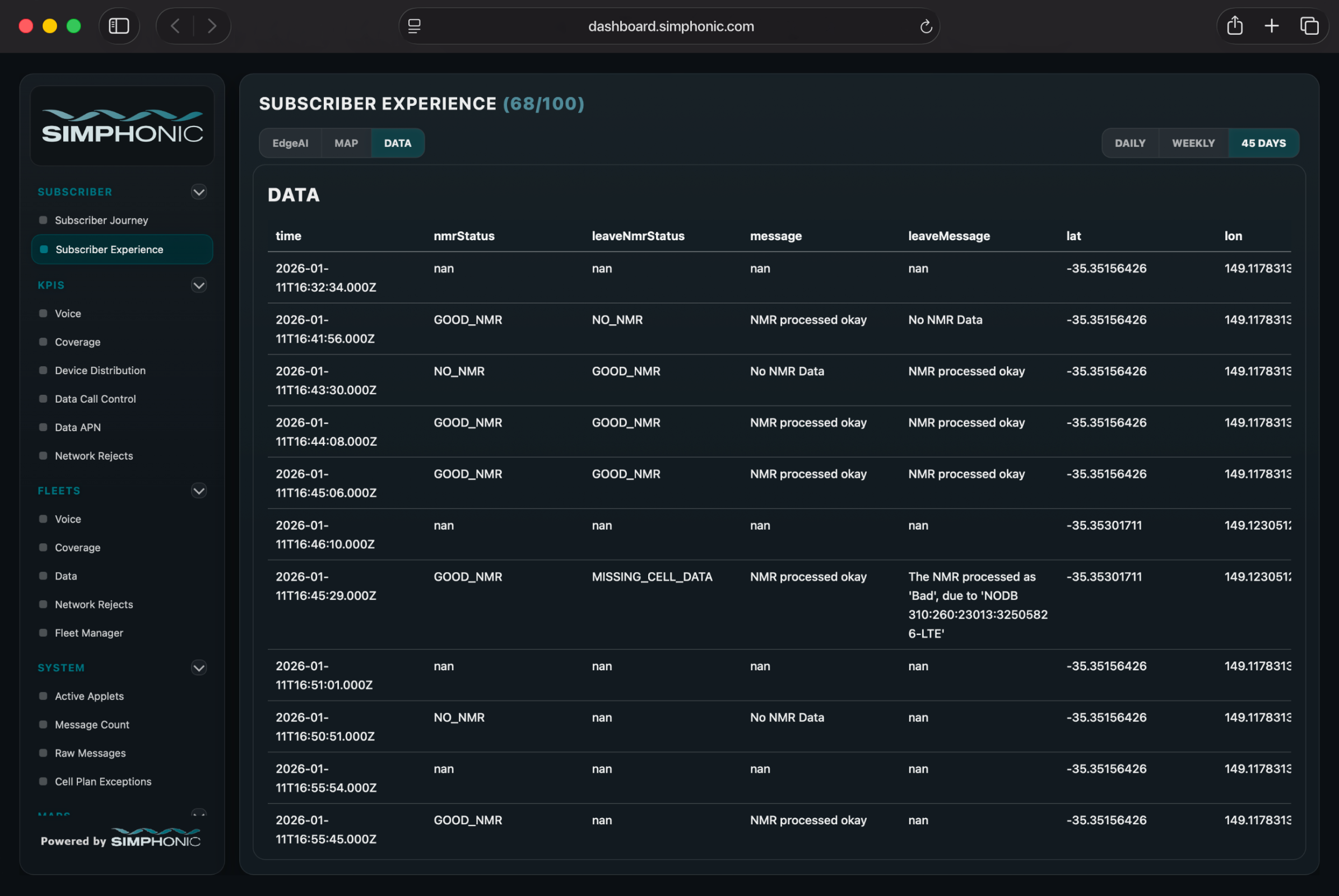
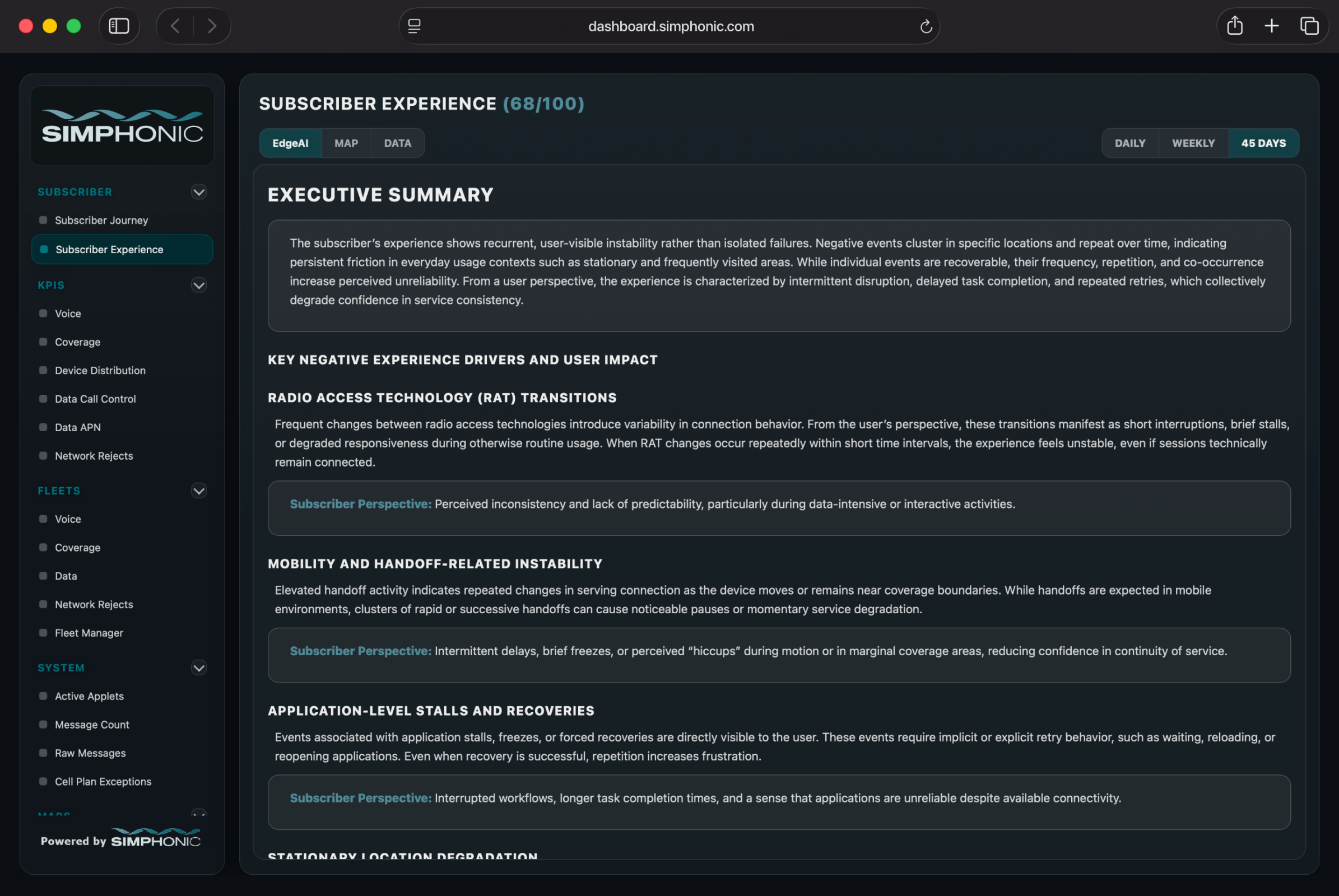

Leveraging a scalable architecture built on Kubernetes and Kafka, our system ingests KPIs directly from the SIM. Due to the defined datasets captured at the device level, complexity and uniformity of data is controlled, allowing the platform to handle terabytes of information without the overhead of distributed computing systems or scaled cloud infrastructure.

Raw data is meaningless without context. Our AI algorithms correlate distinct data points—such as network rejection events, cell handover failures, and radio environment conditions—to build a comprehensive picture of macro events taking place, or granular insight into an individual user journey. By aggregating and analyzing the natural distribution of devices, the system can benchmark performance by location, roaming partner, network load and even device make and model.

Using proprietary algorithms like EdgeGEO, the platform applies machine learning to Network Measurement Reports (NMRs) to accurately determine latitude and longitude. This allows for precise mapping of coverage holes and congestion zones even if devices are indoors or without active GPS, effectively eliminating the "blind spots" inherent in traditional drive testing.

Leveraging a scalable architecture built on Kubernetes and Kafka, our system ingests KPIs directly from the SIM. Due to the defined datasets captured at the device level, complexity and uniformity of data is controlled, allowing the platform to handle terabytes of information without the overhead of distributed computing systems or scaled cloud infrastructure.
Raw data is meaningless without context. Our AI algorithms correlate distinct data points—such as network rejection events, cell handover failures, and radio environment conditions—to build a comprehensive picture of macro events taking place, or granular insight into an individual user journey. By aggregating and analyzing the natural distribution of devices, the system can benchmark performance by location, roaming partner, network load and even device make and model.
Using proprietary algorithms like EdgeGEO, the platform applies machine learning to Network Measurement Reports (NMRs) to accurately determine latitude and longitude. This allows for precise mapping of coverage holes and congestion zones even if devices are indoors or without active GPS, effectively eliminating the "blind spots" inherent in traditional drive testing.

Traditional network field monitoring is reactive, often relying on periodic drive-test data or customer complaints to flag issues. The Simphonic platform shifts this paradigm to Proactive Intelligence. By applying predictive analytics to the ingested data, we move beyond simple reporting to provide foresight and the near real-time data required for automated control.

Instead of merely reporting a dropped call after it happens, our analytics engine analyzes trends in signal degradation and connect attempts invisible to network reporting to anticipate network congestion and service disruptions before they impact a critical mass of users. This allows engineering teams to prioritize infrastructure investment or network optimizations exactly where capacity is needed most.

The platform significantly reduces "No Fault Found" returns and technical support costs by providing Customer Care Agents with instant root-cause visibility. The system intelligently distinguishes between coverage gaps, roaming failures, and device malfunctions, enabling agents to resolve issues on the first call.

By identifying high-value customers who are experiencing chronic poor quality of experience (QoE)—such as frequent drops or Wi-Fi calling issues—operators have the option of intervening with retention offers before subscriber defection.

Leverage network comparison measurements and EdgeAI for a visual representation of coverage superiority over competitors in discrete geographies to enable proactive subscriber acquisition campaigns.

Instead of merely reporting a dropped call after it happens, our analytics engine analyzes trends in signal degradation and connect attempts invisible to network reporting to anticipate network congestion and service disruptions before they impact a critical mass of users. This allows engineering teams to prioritize infrastructure investment or network optimizations exactly where capacity is needed most.

The platform significantly reduces "No Fault Found" returns and technical support costs by providing Customer Care Agents with instant root-cause visibility. The system intelligently distinguishes between coverage gaps, roaming failures, and device malfunctions, enabling agents to resolve issues on the first call.

By identifying high-value customers who are experiencing chronic poor quality of experience (QoE)—such as frequent drops or Wi-Fi calling issues—operators have the option of intervening with retention offers before subscriber defection.

Leverage network comparison measurements and EdgeAI for a visual representation of coverage superiority over competitors in discrete geographies to enable proactive subscriber acquisition campaigns.


Get Started
Fill out the form below to request a trial of the Simphonic platform and we'll be in touch.


Simphonic US
Simphonic Inc.
722 E. Market Street
Ste #102
Leesburg, VA 20176
United States
Simphonic UK
Simphonic Inc.
Vanguard House,
Keckwick Lane,
Daresbury, Cheshire,
WA4 WAB, U.K.
© 2026 Simphonic Inc.
PRIVACY POLICY
Register to request
SIM – The Nerve Center of Operations in the Age of AI
by Chetan Sharma